Best Baitcasting Reels for Bass by Technique (Gear Ratios)
Five baitcasting reels for bass sorted by technique: jigs, finesse, crankbaits, topwater and frogs, with the gear ratio to pick for each. One I fish daily.
The short answer
Pick the reel for your technique, then the gear ratio. My daily reel is the Shimano SLX DC 150 (6.3:1) for jigs and finesse, with the Curado K (7.4:1) as a jig step-up. For crankbaits I'd look at the Daiwa Tatula X TW 100 (6.3:1), and for topwater and frogs the Lew's Mach 2 (7.5:1).
Top picks at a glance
| Product | Best technique | Ratio to buy | Bearings | Where to buy |
|---|---|---|---|---|
| Best all-around (I fish this one) Shimano Shimano SLX DC 150 | Jigs and finesse | 6.3:1 | 4+1 | Check price (Shimano SLX DC 150, affiliate link, opens in a new tab) |
| Best step-up for jigs Shimano Shimano Curado K 200 | Jigs | 7.4:1 | 6+1 | Check price (Shimano Curado K 200, affiliate link, opens in a new tab) |
| Best value, no digital brake Shimano Shimano SLX (non-DC) | Finesse | 6.3:1 finesse, 7.2:1 jigs | 3+1 | Check price (Shimano SLX (non-DC), affiliate link, opens in a new tab) |
| Best for crankbaits Daiwa Daiwa Tatula X TW 100 | Crankbaits | 6.3:1 | 5+1 | Check price (Daiwa Tatula X TW 100, affiliate link, opens in a new tab) |
| Best for topwater and frogs Lew's Lew's Mach 2 | Topwater and frogs | 7.5:1 | 9+1 | Check price (Lew's Mach 2, affiliate link, opens in a new tab) |
Shimano Shimano SLX DC 150
Best for: Jigs, finesse baits and spinners
My daily baitcaster for two years. Digital brake with four modes, metal Hagane body, handles everything I throw. Hands-on pick.
Pros
- One reel for jigs, finesse and spinners
- Four-mode digital brake is forgiving
- Good for experienced anglers and people learning baitcasters
Cons
- Limited to four brake modes
- Struggles casting directly into the wind
Shimano Shimano Curado K 200
Best for: Jigs and general power fishing
Shimano's step-up reel with more bearings, MicroModule gearing and a wide-range external brake. I haven't fished it myself; this entry rests on brand reputation, owner reviews and independent research.
Pros
- Premium Shimano build with 6+1 bearings
- Externally adjustable SVS Infinity brake
- Ratios from 6.2:1 to 8.5:1
Cons
- Costs noticeably more than the SLX
Shimano Shimano SLX (non-DC)
Best for: Finesse and budget-minded anglers
The same compact platform as my SLX DC without the digital control, at a lower price. I haven't fished this exact version; this entry rests on brand reputation, owner reviews and independent research.
Pros
- Shimano build at a lower price
- Comes in 6.3:1, 7.2:1 and 8.2:1
- Compact, lightweight body
Cons
- Traditional brake takes more setup than the DC version
Daiwa Daiwa Tatula X TW 100
Best for: Crankbaits and other reaction baits
A compact Daiwa with the T-Wing line guide and Magforce-Z brake. Crankbaits are not my main technique, so this entry rests on brand reputation, owner reviews and independent research.
Pros
- Light at about 6.9 oz
- Slower 6.3:1 ratio suits cranking
- Casting-friendly T-Wing guide
Cons
- Models and ratios vary, so check the page
Lew's Lew's Mach 2
Best for: Topwater, frogs and power fishing
A fast 7.5:1 reel for picking up slack and winching fish out of cover. I haven't fished it; this entry rests on brand reputation, owner reviews and independent research.
Pros
- Fast 7.5:1 ratio picks up slack quickly
- 9+1 bearings and a graphite frame
- Magnetic braking system
Cons
- Too fast for some crankbaits, per one hands-on review
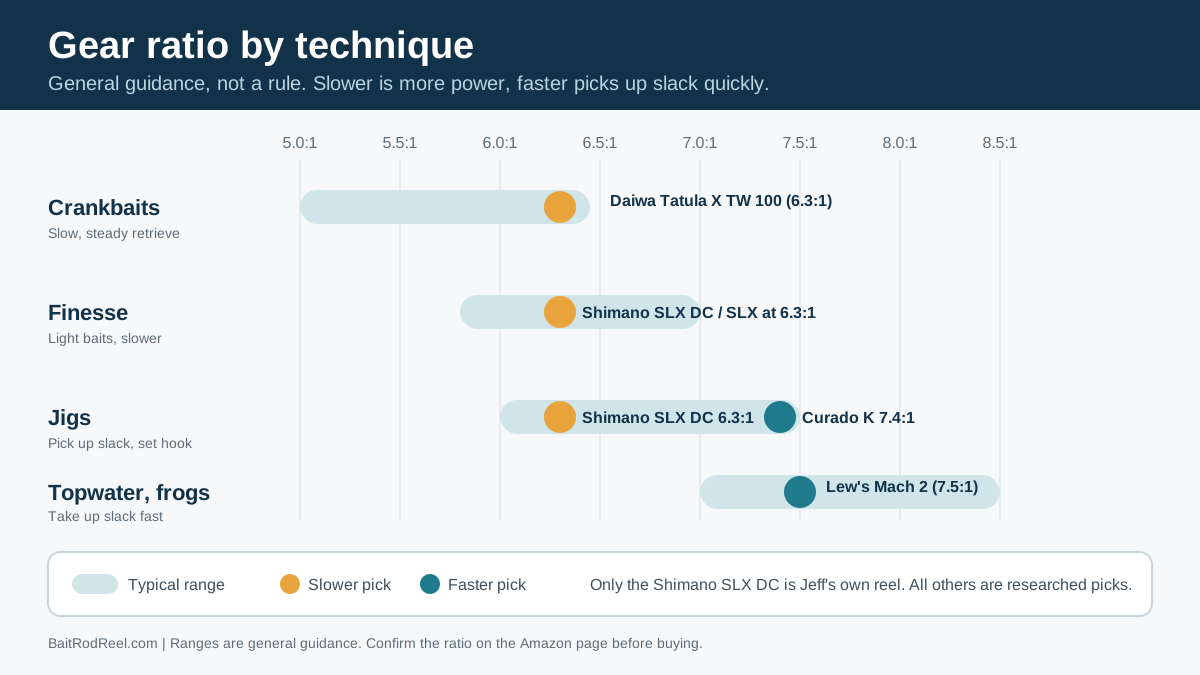
Most reel roundups rank reels by price. I would rather sort them by what you are going to throw, because the right reel for a jig is not always the right reel for a crankbait. Pick your technique, then pick the gear ratio. The Amazon pages for most of these cover several ratios, so I call out which one to select.
A quick note on how I wrote this
I fish the Shimano SLX DC 150 myself, so that entry comes from two years on the water. Every other reel here rests on brand reputation, owner reviews and independent research, and I say so each time. I lean toward Shimano reels, and I will say so when it matters.
Gear ratio in one minute
Gear ratio tells you how many times the spool turns for every turn of the handle. A 6.3:1 reel turns the spool 6.3 times per crank. Slower reels give you more cranking power and are easier to keep a steady retrieve with. Faster reels pick up slack line quickly, which is useful for jigs and topwater baits.
Jigs
Shimano SLX DC 150 (6.3:1). This is the reel I jig with. Once a jig is on bottom, a moderate ratio is plenty for me, and the digital brake keeps casts clean. If you want faster slack pick-up, Shimano also makes the SLX DC in 7.2:1.
Check price on Amazon (affiliate link, opens in a new tab)Step up: Shimano Curado K 200 (7.4:1). The Curado is Shimano’s step up, with 6+1 bearings, MicroModule gearing and a wide-range external brake. Pick the 7.4:1 on the Amazon page for jigs.
Check price on Amazon (affiliate link, opens in a new tab)Finesse
Shimano SLX DC 150 (6.3:1) is my finesse reel, too. If you want the same platform without the digital brake, the non-DC Shimano SLX is the value pick. For finesse, choose the 6.3:1 on the Amazon page. If you plan to jig with it, the 7.2:1 is the better choice.
Check price on Amazon (affiliate link, opens in a new tab)Crankbaits
Crankbaits are not my main technique, so I am relying on research here. A slower reel keeps a steady, comfortable retrieve with baits that pull against the water, and anglers often prefer ratios around 6:1 or lower for it. The Daiwa Tatula X TW 100 is a compact, popular choice. Select the 6.3:1 on the Amazon page. Note that retailers differ on exactly which ratio goes with which model code, so confirm the ratio on the page before you buy.
Check price on Amazon (affiliate link, opens in a new tab)Topwater and frogs
When a frog is sitting in the pads and a fish blows up on it, you want to take up slack fast. That is where a quick ratio helps. The Lew’s Mach 2 (7.5:1) is a budget-friendly pick built for it. One hands-on reviewer found 7.5:1 a bit fast for crankbaits but liked it for power fishing, which is why it sits in this section.
Check price on Amazon (affiliate link, opens in a new tab)How to choose
- Decide the technique you will fish most.
- Match the ratio to the technique using the chart above.
- Choose your brake: digital control if you want easy casting, a traditional brake if you prefer to tune it yourself.
- Decide your budget, then confirm the ratio and hand orientation on the Amazon page.
Specs come from manufacturer and retailer tables. Only the Shimano SLX DC 150 entry reflects my own use.
Frequently asked questions
What gear ratio is best for a bass baitcaster?
There is no single best ratio. Slower reels (around 6:1) suit finesse and crankbaits, and faster reels (7:1 and up) help with jigs, topwater and frogs, where picking up slack quickly matters. A mid-range ratio is the safest all-rounder.
What is a digital control (DC) brake?
Shimano's DC reels read what the spool is doing during the cast and adjust the braking automatically, with a few modes you choose from an external dial. It makes baitcasters easier to cast without constant tuning.
Which reel do you actually use?
The Shimano SLX DC 150 in 6.3:1. I have used it for two years for jigs, finesse and spinners.