Guide Bass & Trout Line & Leaders
Mono vs Braid vs Fluoro: Which First Line?
Monofilament, braid or fluorocarbon? How stretch, sink rate and visibility change what you feel and catch, and which line I'd spool on a first rod and reel.
The short answer
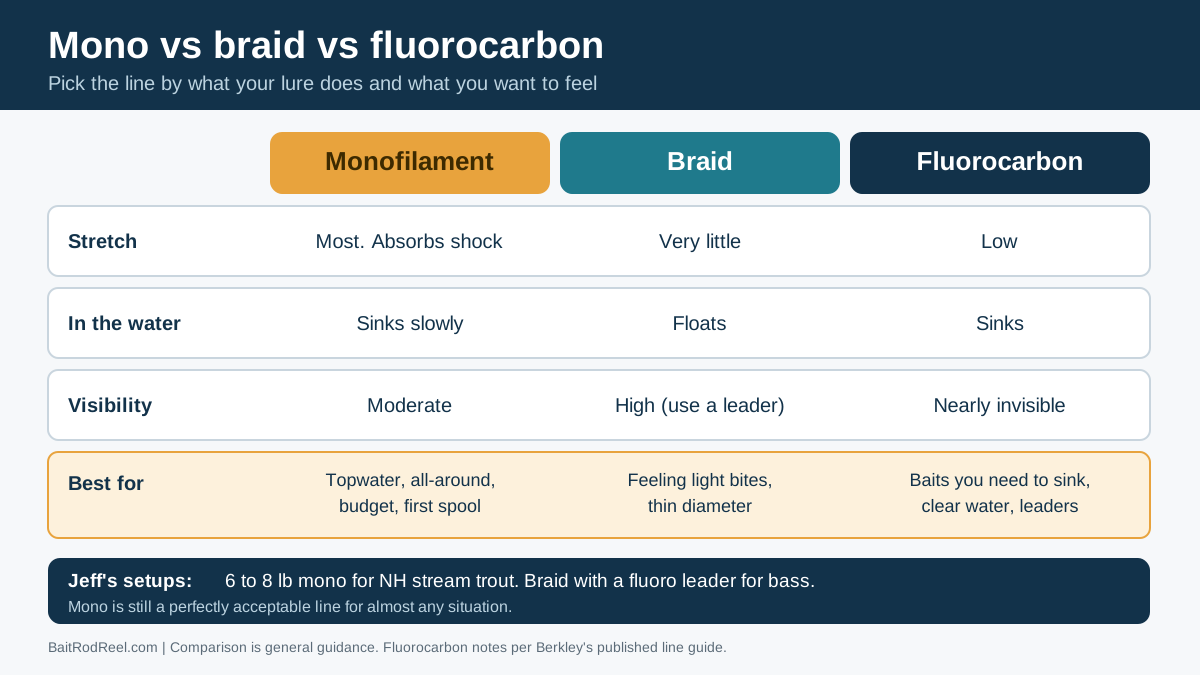
Monofilament is a perfectly acceptable line for almost any situation: it is versatile, affordable and gets the job done, so it is the easy first spool. I moved to braid with a fluorocarbon leader on my bass reel to cut stretch and feel the slightest bite. Pick the line by what your lure does: mono stays up near the surface for topwater, and fluorocarbon sinks for baits you need to drop through the water.
If you are standing in the fishing line aisle trying to pick between mono, braid and fluorocarbon, you are not alone. They all catch fish. The difference is what each one does in the water, and I will tell you where I landed and why.
The short version
- Monofilament: stretchy, forgiving, affordable and versatile. The easy first spool.
- Braid: almost no stretch, very thin for its strength, and it floats.
- Fluorocarbon: low stretch, nearly invisible underwater, and it sinks.
Monofilament: the line that works almost everywhere
I still think mono is a perfectly acceptable line for almost any situation. It is versatile, it is affordable, and it gets the job done. I fished trout in New Hampshire rivers and streams for years on 6 or 8 pound mono, and it was all I needed.
Mono also has a real advantage with certain lures. It sinks slowly, so it stays up near the surface far better than fluorocarbon does, which makes it a good match for topwater lures. Its stretch also absorbs shock when a fish hits hard. The tradeoff is that the stretch dulls what you feel.
Two monos I would point you to
I would look at either of these:
Sufix Advance Monofilament. Wired2Fish describes it as a limp, smooth line that casts well, resists coiling and makes strong knots, and says its HMPE and co-polymer blend gives roughly half the stretch of other monos. It comes in 4 to 25 pound test on 330-yard spools.
Check price on Amazon (affiliate link, opens in a new tab)Berkley Trilene Big Game. A tough, abrasion-resistant mono that OutdoorGearLab calls a versatile, “daily driver” line, with excellent knot strength. The tradeoffs it notes are more stretch than the other lines it tested and some memory, meaning it can coil if left on the reel for a long time. It is available up to 130 pound test.
Check price on Amazon (affiliate link, opens in a new tab)Fluorocarbon: for baits that need to sink
Fluorocarbon is denser than water, so it sinks. That makes it a better choice for lures you need to drop in the water column, like jigs and other baits you want to get down and keep down. It stretches much less than mono and is nearly invisible underwater, which is why it works so well in clear water. Some lures are simply better with fluorocarbon than mono, and it is the one to reach for when the bait needs to sink.
Braid: why I moved to braid plus a fluoro leader
On my bass reel I run braided line with a fluorocarbon leader. I made the switch because I wanted to reduce the stretch in the line and feel even the slightest bite. Both braid and fluorocarbon do that. Both are also thinner in diameter for their pound test, which I use to improve performance on my reel.
Braid is easy to see underwater, which is why I pair it with a fluorocarbon leader in clear water. If you want to see exactly how I set that up, read my braid to fluorocarbon leader guide and my Sufix 832 review.
Check price on Amazon (affiliate link, opens in a new tab) Check price on Amazon (affiliate link, opens in a new tab)Which should you buy first?
My advice:
- Start with mono. It is forgiving, cheap and works almost anywhere. Match the pound test to the line rating printed on your rod.
- Keep a spool of fluorocarbon in mind for lures that need to sink and for clear water.
- Try braid with a fluoro leader when you want more sensitivity and less stretch, which is how I fish bass.
You do not have to switch. Mono is still a great line.
The experience in this guide is my own. Notes on the Sufix Advance and Trilene Big Game come from independent reviews by Wired2Fish and OutdoorGearLab, and the fluorocarbon behavior from Berkley’s published line guide.
Frequently asked questions
What fishing line should a beginner buy?
Monofilament. I think it is a perfectly acceptable line for almost any situation. It is versatile, affordable and gets the job done. For mono I would look at Sufix Advance monofilament or Berkley Trilene Big Game.
Why use braid with a fluorocarbon leader?
I wanted to reduce the stretch in the line and feel even the slightest bite, and both braid and fluorocarbon help with that. Both are also thinner in diameter for their pound test, which improves performance on my reel.
Which lines are best for topwater lures?
Monofilament. It sinks slowly and stays up near the surface, which suits topwater lures. Fluorocarbon sinks, so it is better for lures you need to drop in the water column.
Is fluorocarbon better than monofilament?
It depends on the lure. Some lures are better with fluorocarbon, mostly the ones you need to sink. Mono is the better choice for topwater and for general, all-around fishing.
What line did you use for trout?
Usually 6 or 8 pound monofilament, fished with small Mepps Aglia spinners.