Baitcaster Gear Ratio Explained: Which One for Which Bait
What baitcaster gear ratios mean, how 6.3:1, 7.1:1 and 8.2:1 change your retrieve, and which ratio I'd pick for finesse, jigs, crankbaits and cold water.
The short answer
Gear ratio is how many times the spool turns for each turn of the handle, so a higher number means faster line pickup. If you want one reel for everything, I like 6.3:1 because you can always reel faster or slower without losing much of the action. Go faster for jigs, topwater and frogs, and slower when the water is cold and the bite is slow.
Gear ratio is the number on the box that most beginners skip past, and it matters more than it looks. Here is what it means, what it changes on the water, and how I pick one.
What gear ratio means
A gear ratio like 6.3:1 tells you how many times the spool turns for every full turn of the handle. At 6.3:1, one crank spins the spool 6.3 times. The bigger the first number, the faster the reel picks up line.
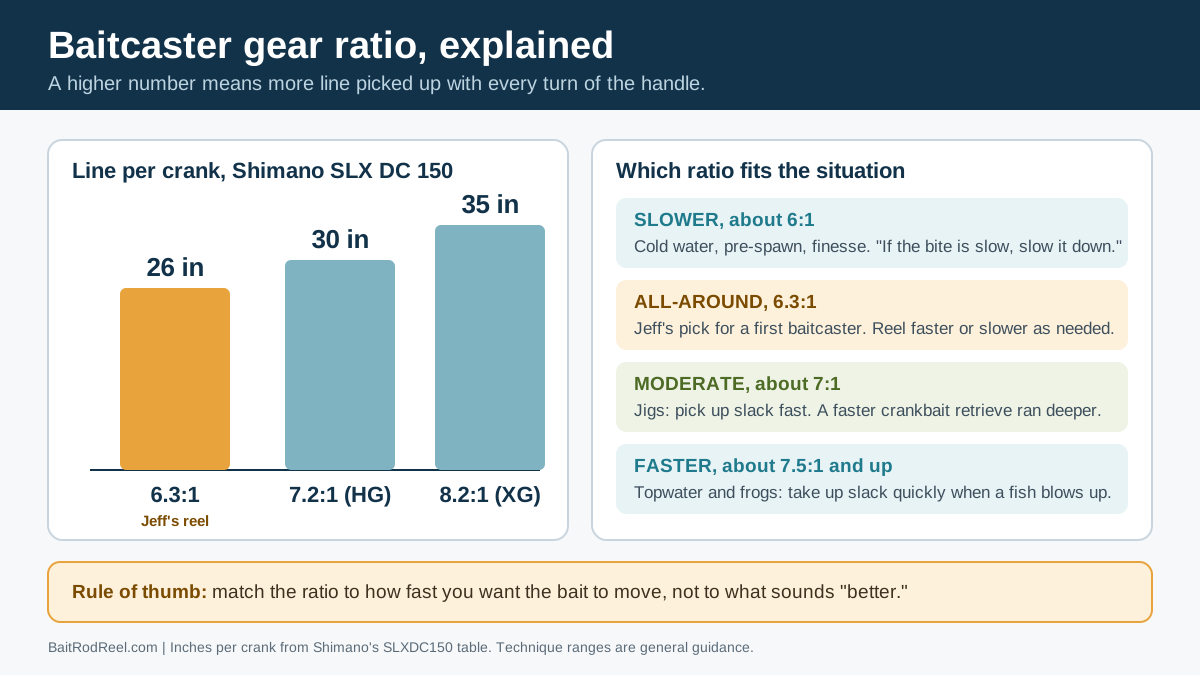
You can see it in the inches of line you gain per crank. Shimano’s published numbers for the SLX DC 150 show how the three ratios differ:
- 6.3:1: about 26 inches per crank
- 7.2:1 (HG): about 30 inches per crank
- 8.2:1 (XG): about 35 inches per crank
Faster ratios are not “better” and slower ones are not “weaker.” They are tools for different jobs.
What I use, and why
I fish a 6.3:1 Shimano SLX DC 150 for nearly everything. I fish finesse style, so I don’t need high gear ratios for my retrieves. I like 6.3:1 because it seems good for all types of fishing, and you can always reel in faster or slower when you want to without losing a lot of the action. You can read more in my SLX DC 150 review.
I believe I have also fished a 7.2:1, and the only difference I noticed was with crankbaits. With the faster retrieve, the bait ran deeper. That is just one angler’s experience, but it makes sense that a faster retrieve changes how a crankbait runs.
Slow the bait down in cold water
My rule is simple: if the bite is slow, slow the bait down. Cold water is the clearest example, especially pre-spawn, because bass don’t do a lot of moving then. On those days a slower retrieve is what makes sense, and you should outfit for it, which is where a slower reel earns its spot.
General guidance by technique
Everything below is general guidance used across the bass fishing world, not my own testing. Treat it as a starting point.
- Finesse baits: slower to moderate ratios, around 6:1. You are working light baits slowly, and you rarely need to pick up line quickly.
- Crankbaits: this one depends on what you want. A slower reel is comfortable for a steady retrieve, and a faster reel can get the bait deeper, as I noticed.
- Jigs: moderate to fast, around 7:1. Picking up slack quickly helps you stay in contact and set the hook.
- Topwater and frogs: faster, around 7.5:1. When a fish blows up on a frog, you want to take up slack fast.
Which one should you buy?
If you are buying your first baitcaster and you do not know where to start, I would hand you the 6.3:1. It covers a lot of ground, and it is easy to adapt. If you already know you will fish mostly jigs or frogs, step up to a faster ratio, and if you will spend most of your time in cold water or fishing slowly, stay with the slower one.
For picks matched to each technique, see my best baitcasting reels for bass by technique roundup. The reel I use is below. The Amazon page covers several ratios, so select the one you want before ordering.
Check price on Amazon (affiliate link, opens in a new tab)Experience sections are my own. Inches-per-crank figures come from Shimano’s published SLX DC 150 table. The technique ranges are general guidance.
Frequently asked questions
What does a 6.3:1 gear ratio mean?
The spool turns 6.3 times for every full turn of the handle. On the Shimano SLX DC 150, that works out to about 26 inches of line per crank.
What gear ratio is best for a first baitcaster?
I like 6.3:1. It seems to work for all types of fishing, and you can reel in faster or slower when you want to without losing a lot of the action.
Does a faster gear ratio make a crankbait dive deeper?
In my experience, yes. When I fished a faster reel (I believe a 7.2) I noticed a slight difference with crankbaits, and the bait ran deeper with the faster retrieve.
What gear ratio should I use in cold water?
A slower one. In cold water, especially pre-spawn, bass don't move much, so I follow one rule: if the bite is slow, slow the bait down.
Do I need a high gear ratio for finesse fishing?
No. I fish finesse style, so I don't need a high gear ratio for my retrieves.