How to Fish a Football Jig for Bass: Drag, Hop and Set the Hook
How I fish football jigs for bass: the drag-and-sweep retrieve, a hop pattern that never repeats, where to cast, and why you should always set the hook.
The short answer
Cast a football jig as far as you can into the target area, let it sink, then drag it along the bottom with a back-to-front sweep while reeling in the slack. When you feel a tap, reel in the slack and set the hook right away, even if nothing is there.
A jig is one of the most reliable bass baits you can tie on, and it is also one of the easiest to fish wrong. I am still improving at it myself, so I am writing this the way I wish someone had explained it to me: what I throw, how I work it, where I cast it, and what to do the moment you feel something.
What I throw
I stick with football jigs in 3/8 and 1/2 ounce. In the conditions I fish, I do not need to go lighter, and I do not need to go heavier for the depth or the cover I am in. Those two sizes work well on their own, so I keep it simple.
For trailers, I mostly throw paddle tails these days. When the bite is finicky, a smaller-profile grub or curly tail trailer works just fine. My favorite color combination is a green pumpkin jig paired with a Googan Squad Bandito Bug. Depending on how I retrieve it, it looks like either a crawfish or a bluegill. The Bandito Bug is a soft plastic craw about 4 inches long with six legs and two antennae, and the legs keep moving as the bait falls and moves.
Check price on Amazon (affiliate link, opens in a new tab)The Amazon listing covers different sizes and colors, so check the pack size and color on the page.
My setup for jigs
I fish jigs on the same combo I use for most things: an Abu Garcia Vendetta rod and a Shimano SLX DC reel, spooled with Sufix 832 braid. I have the sensitivity dialed up enough that I can feel whether the jig is on soft bottom, rocks, weeds, or whatever else it runs into. That is the real advantage of a light, sensitive rod with a jig, because the bottom tells you what the jig is touching. You can read about each piece in my Vendetta review, SLX DC review and Sufix 832 review, and how the line is rigged in my braid to fluorocarbon leader guide.
The drag: my most successful retrieve
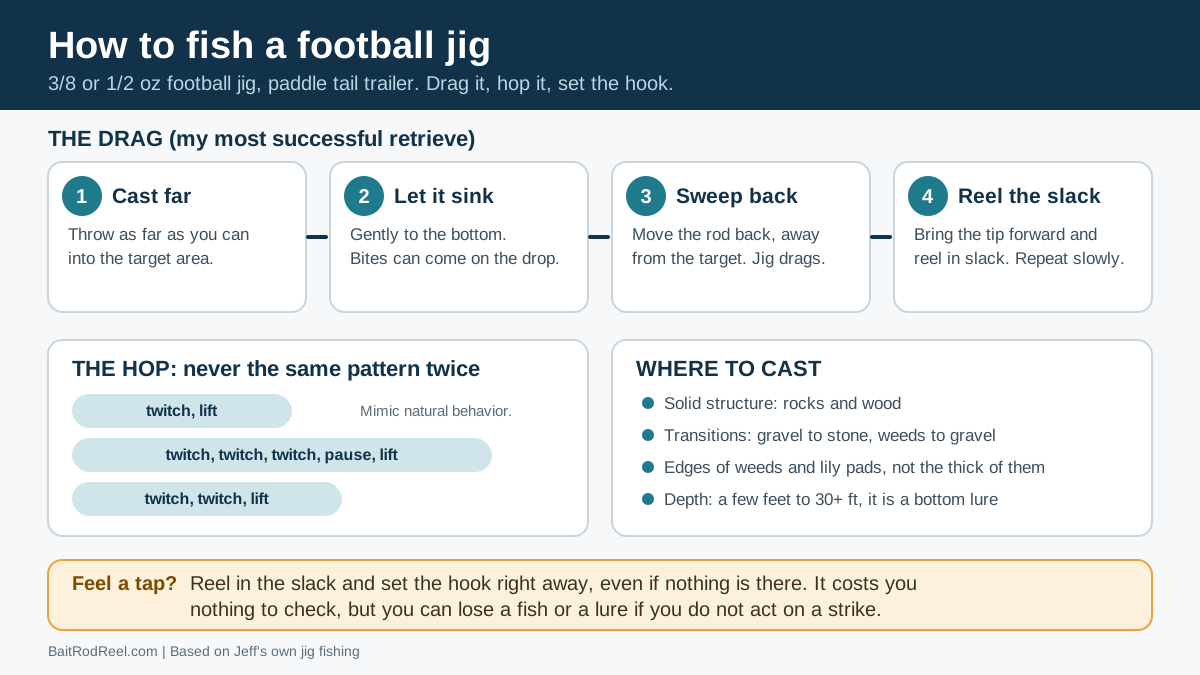
Dragging the jig along the bottom has been the most successful retrieve for me. It is a back-to-front motion, and here is the whole cycle:
- Cast as far as you can into the target area.
- Let the jig sink gently to the bottom. Watch your line as it falls, because a fish can hit it on the way down.
- Sweep the rod back and away from the target, which pulls the jig along the bottom.
- Bring the rod tip forward toward the target again while reeling in the slack.
- Repeat, slowly, covering the area.
Think of the sweep as the part that moves the jig and the reeling as the part that keeps you in contact with it. Done slowly, you feel every change in the bottom.
Hopping the jig
Hopping works too, but you have to present it in a way that is not a set pattern. A repeated rhythm, like twitch-twitch-lift over and over, is something bass have probably seen before. Alternate it:
- twitch, lift
- twitch, twitch, twitch, pause, lift
- twitch, twitch, lift
Every action you put on the lure should be different from the last. You are trying to mimic natural behavior, and in most waters bass have seen plenty of lures and are keen on what is fake and what is real.
Feeling the bite and setting the hook
Depending on what the fish is doing, there are a couple of things to feel for:
- On the initial drop. If you are lucky enough to cast into fish, you can get a bite just as the jig sinks.
- A slight tap. If you have to work it, a light tap is what you will feel most times.
When you feel it, reel in the slack and set the hook quickly. And do not be afraid to set the hook even if nothing is there. An angler once told me a rule that stuck with me: it costs you nothing to see if you have a fish, but you can lose a fish, a lure, or both if you get a strike and do not act on it.
Where to fish a jig
A jig is a bottom-fishing lure. Depending on your water and the time of year, you can fish one as shallow as a few feet or as deep as 30 feet or more.
- Solid structure: the best places are usually near rocks and wood.
- Transitions: bass like terrain that changes, such as gravel to stone, or weeds to gravel.
- Weeds and lily pads: you can fish around them, but stick to the edges and stay out of the thick of them.
Quick recap
- Football jig, 3/8 or 1/2 ounce, with a paddle tail trailer (a smaller grub or curly tail when the bite is finicky).
- Drag it slowly with a sweep and reel-in-the-slack motion, or hop it with a pattern that keeps changing.
- Fish rocks, wood, transitions, and the edges of weeds and pads.
- When you feel a tap, reel in the slack and set the hook.
This guide is based on my own experience fishing football jigs, plus one tip I picked up from another angler. Details on the Bandito Bug come from the manufacturer’s published description.
Frequently asked questions
What size football jig should I use for bass?
I stick with 3/8 and 1/2 ounce football jigs. In the conditions I fish, I don't need to go lighter, and I don't need to go heavier for the depth or cover. Those two sizes work well on their own.
What is the best way to retrieve a jig?
Dragging it along the bottom has been the most successful for me. Cast out, let the jig sink gently to the bottom, sweep the rod back and away from the target, then bring the tip forward while reeling in the slack.
How should I hop a jig?
Never use the same pattern twice. Mix it up, for example twitch-lift, then twitch-twitch-twitch-pause-lift, then twitch-twitch-lift. Bass have seen plenty of lures and can tell fake from natural, so vary what you do.
How deep do you fish a jig?
Anywhere from a few feet to 30 feet or more, depending on the body of water and the time of year. Jigs are a bottom-fishing lure, so you adjust to wherever the bottom is.
What should I do when I feel a bite on a jig?
Reel in the slack and set the hook quickly. Don't worry if nothing is there. It costs you nothing to check, but you can lose a fish, a lure, or both if you ignore a strike.