How to Texas Rig a Senko
How I Texas rig a 5-inch Senko on a 3/0 EWG hook, why I usually fish it weightless, when I add a light bullet weight, and when I pick it over a wacky rig.
The short answer
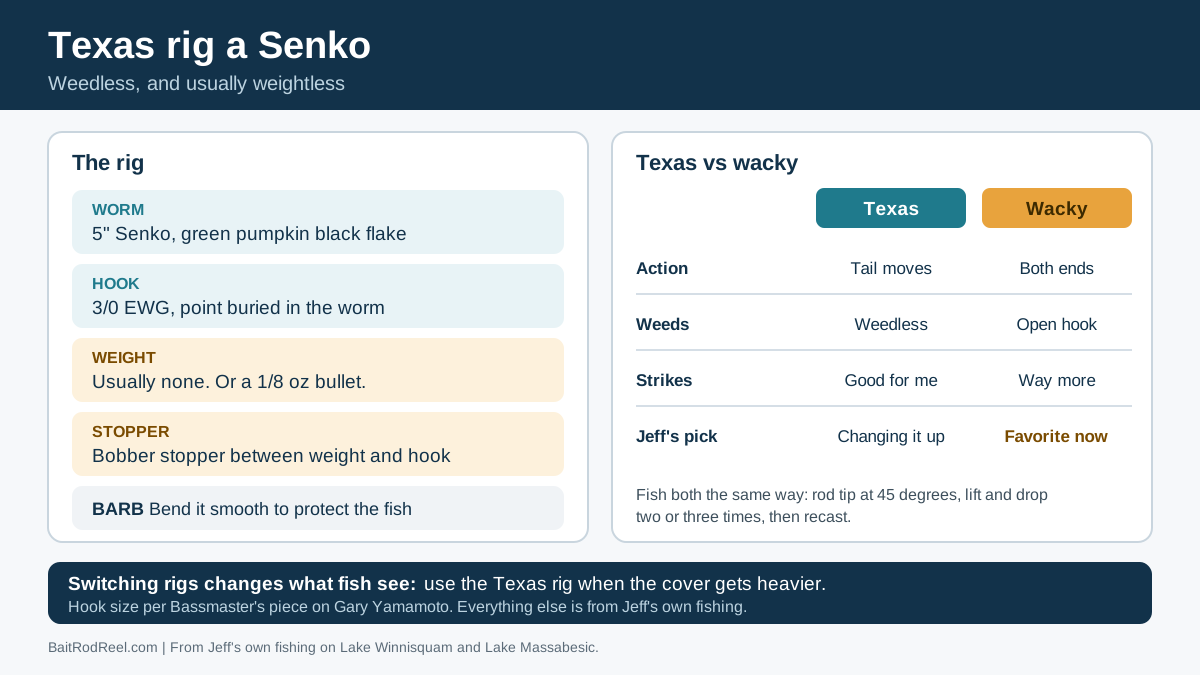
Rig a 5-inch Senko on a 3/0 extra-wide-gap hook with the point buried in the worm so it stays weedless, and fish it weightless most of the time. When I do add a weight, I use a light bullet weight with a bobber stopper between the weight and the hook to cut down on line fray. I prefer a wacky rig overall, but the Texas rig is the better choice around heavier weeds and structure.
I prefer a wacky rig for a Senko these days, but the Texas rig is the one I turn to when I want to fish heavier weeds and structure. It is simple, and I almost never need a weight to make it work.
What you need
- A 5” Yamamoto Senko. I only use green pumpkin with black flake, color 297.
- A 3/0 extra-wide-gap (EWG) hook.
- Optional: a light bullet weight and a bobber stopper.
The hook size
For a 5-inch Senko, I use a 3/0 EWG hook. That is also the size Bassmaster says Gary Yamamoto uses to rig the 5-inch Senko weightless on a Texas rig. Before you order, check that the page has the 3/0 size selected.
How to rig it
- Push the hook point into the head of the worm and bring it out the side.
- Slide the worm up the hook until the head of the worm covers the eye.
- Turn the hook around and push the point back into the body of the worm, so the point is buried.
Burying the hook in the worm is what makes the rig weedless, which is the whole reason to choose it over a wacky rig.
Fish it weightless
I hardly ever use a weight with this rig. Weightless gives the worm the most action and keeps it falling slowly.
When I do want a little weight, I use a light bullet weight, 1/8 oz. I add a bobber stopper on the line between the weight and the hook. The stopper cushions the knot from the weight and reduces the friction that frays the line.
Check price on Amazon (affiliate link, opens in a new tab) Check price on Amazon (affiliate link, opens in a new tab)Bend the barb down
Whenever I use hooks for soft plastics, I bend the barb so it is smooth. I have struggled with gut hooking bass, and keeping the barb bent smooth gives me much better success saving the fish without hurting it.
I highly recommend this to any angler, especially newer ones, who are more likely to let a fish swallow the worm before setting the hook.
How I fish it
I fish a Texas rigged Senko the same way I fish a wacky rig:
- Cast it out and let it sink on a nearly slack line, with the rod tip at about 45 degrees.
- If nothing hits, lift the rod tip and let the worm fall again, reeling in the slack when it touches bottom.
- Try it two or three times, then recast somewhere else.
The full step-by-step, including how to set the hook, is in my wacky rig guide. It works the same way here.
Texas rig or wacky rig?
Here is how I think about it:
- Wacky rig: my favorite now. Both ends of the worm move as it falls, and it produces more strikes for me.
- Texas rig: only the tail end of the worm is free to move as it sinks, so it looks different to the fish. That is a good reason to use it, because switching rigs changes what the fish see.
- Weeds and structure: go with the Texas rig, because the hook is buried in the worm and stays weedless.
I fish both on or around rocks, weeds, lily pads and wood, usually in less than 15 feet of water. You can see how this fits with the rest of my box in my guide to the best bass lures for New England lakes.
Line and gear
I use braid with a fluorocarbon leader, 8 to 12 lb for both, on my baitcaster. Fluorocarbon helps the worm sink naturally and is nearly invisible in clear water. My braid to fluorocarbon leader guide shows how I set that up.
Check price on Amazon (affiliate link, opens in a new tab)Quick recap
- 5” Senko on a 3/0 EWG hook, point buried in the worm.
- Weightless most of the time. A 1/8 oz bullet weight with a bobber stopper when needed.
- Fish it like a wacky rig: 45 degree rod tip, lift and drop two or three times, then recast.
- Pick the Texas rig for heavier weeds and structure, and bend the barb smooth.
Everything in this guide is from my own fishing. The hook size note comes from Bassmaster’s published piece on Gary Yamamoto.
Frequently asked questions
How do you Texas rig a Senko?
I use an EWG hook and bury the hook point in the worm so the rig is weedless. Most of the time I fish it with no weight at all.
What size hook for a 5-inch Senko?
A 3/0 extra-wide-gap hook is the size I use, and it is the size Gary Yamamoto himself is quoted using on a weightless Texas rig for the 5-inch Senko.
Do you put a weight on a Texas rigged Senko?
I hardly ever do. When I do, I use a light bullet weight, 1/8 oz, and put a bobber stopper on the line between the weight and the hook to reduce the friction that frays the line.
Is a Texas rig or a wacky rig better for a Senko?
I prefer the wacky rig now, because only the tail of a Texas rigged worm moves as it sinks. But the Texas rig is better for more weeds and structure, because you can bury the hook in the worm for weedless action. It is also a good way to change up what the fish are seeing.
Why bend the barb down on a hook for soft plastics?
I struggled with gut hooking bass. Keeping the barb bent smooth helps me save the fish and not hurt it. I recommend it to every angler, especially newer ones, who are more likely to let a fish swallow the worm before setting the hook.
How do you fish a Texas rigged Senko?
The same way I fish a wacky rig: let it sink on a nearly slack line with the rod tip at about 45 degrees, lift it, let it fall again, and recast after two or three tries.