How to Wacky Rig a Senko
How I wacky rig a 5-inch Senko with an O-ring, why most strikes come on the first drop, how to work it, and the line and hook that go with it.
The short answer
Slide an O-ring onto the thick middle of a 5-inch Senko, hook the ring with a small hook, cast it and let it sink on a slack line. In my experience 80 to 90 percent of strikes come on that first drop, so keep your rod tip at about 45 degrees with very little slack. If nothing hits, lift the rod tip high, let it fall again, and move on after two or three tries.
Wacky rigging is quickly becoming my favorite way to fish a Senko. It produces way more strikes for me than I usually get, and it is also one of the simplest rigs to learn. Here is exactly how I do it.
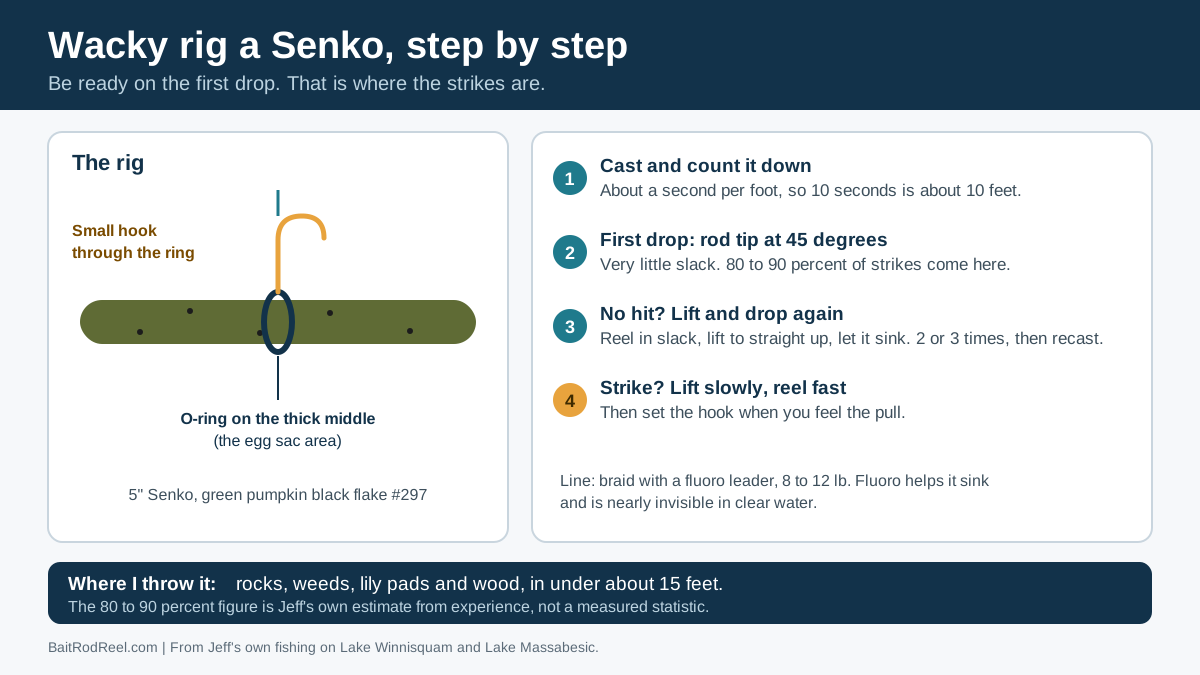
What you need
- A 5” Yamamoto Senko. I only use green pumpkin with black flake, color 297. My lakes are very clear, and natural colors work best.
- O-rings.
- A small hook. I use the same small hook I use for drop shotting.
- Fluorocarbon line or a fluorocarbon leader.
Check the O-ring listing before you order to make sure it is the size and type you want for a 5-inch worm.
How to rig it
- Slide an O-ring onto the Senko and sit it on the thick middle of the worm, the area some anglers call the egg sac.
- Hook the ring with your hook. The hook rides on the ring, so the worm hangs from its middle.
The ring is what keeps the rig together, and both ends of the worm are free to move as it falls.
The drop is everything
Cast it out and let the worm do the work. The worm’s action as it falls is the lure. I do not add anything to it.
Anglers need to be ready on that first drop. In my experience, 80 to 90 percent of strikes happen as the worm falls for the first time. So the way you hold your rod matters:
- Point the rod tip at about 45 degrees.
- Keep very little slack in the line.
That setup lets you feel a hit on the line quickly and react right away.
Count it down
My Senko, hook and O-ring together sink at about a second per foot. So if you count ten seconds, the worm is about ten feet down. I fish this in water under about 15 feet, so I am never waiting long for it to reach the bottom.
What to do when it hits the bottom
If nothing hit on the way down:
- Reel in the slack after it touches bottom.
- Lift the worm by raising the rod tip all the way until it points straight up.
- Let it sink back down to the bottom, and reel in the slack again.
- Do that two or three times, then reel in and recast somewhere else.
Do not sit in one spot. The first drop is where the strikes are, so more casts to more places is better than more lifts in one spot.
When you feel a strike
Slowly lift the rod tip while reeling in line at a fairly quick pace, so you know the hook is in the fish’s mouth. When you feel that pull, set the hook, and the fight is on.
Bend the barb down
Whenever I use hooks for soft plastics, I bend the barb so it is smooth. I have struggled with gut hooking bass, and keeping the barb bent smooth gives me much better success saving the fish without hurting it. I highly recommend this to any angler, especially newer ones, who are more likely to let a fish swallow the worm before setting the hook.
My setup for it
I fish a wacky rigged Senko on my baitcaster with braid and a fluorocarbon leader, 8 to 12 lb for both, and I put on enough fluorocarbon that the braid usually stays on the reel. It is the same setup I use for everything else.
I choose fluorocarbon for two reasons. It sinks, which helps the worm fall naturally, where mono would fight the worm’s own sink rate. And it is nearly invisible in the very clear water I fish.
Here is more on how I put that line together:
- My braid to fluorocarbon leader guide
- My mono vs braid vs fluorocarbon guide
- My Shimano SLX DC review, the reel I fish it on
Where I throw it
On or around structure: rocks, weeds, lily pads and wood, anywhere fish may be holding. I use it all season long, and it is one of the lures I never leave home without. You can read about the rest of my box in my guide to the best bass lures for New England lakes. When the weeds get heavier, I switch to a Texas rig for a weedless presentation.
Quick recap
- 5” Senko, O-ring on the thick middle, small hook through the ring.
- Rod tip at 45 degrees, very little slack, and be ready on the first drop.
- Count it down at about a second per foot.
- Lift to straight up and drop it again two or three times, then recast.
- On a strike, lift slowly, reel fast, then set the hook.
Everything in this guide is from my own fishing. The 80 to 90 percent figure is my own estimate from experience, not a measured statistic.
Frequently asked questions
How do you wacky rig a Senko?
I put an O-ring on the Senko and hook the ring with a small hook, the same kind I use for drop shotting. The O-ring sits on the thickest part of the worm, the area some people call the egg sac, so the worm hangs by its middle and both ends move as it falls.
Where do you put the O-ring on a Senko?
On the thick middle of the worm, the egg sac area.
How fast does a wacky rigged Senko sink?
About a second per foot with the worm, hook and O-ring together, so ten seconds is about ten feet. That makes it easy to count the bait down.
When do bass hit a wacky rigged Senko?
In my experience about 80 to 90 percent of strikes come on the first drop. That is why I keep the rod tip up and the line tight as it falls.
How do you set the hook on a wacky rig?
When I feel a strike, I slowly lift the rod tip while reeling in line at a fairly quick pace so the hook is in the fish's mouth. When I feel the pull, I set the hook.
Should you bend the barb on a wacky rig hook?
I do. I bend the barb smooth on hooks for soft plastics, because I struggled with gut hooking bass and this helps me save the fish without hurting it. I recommend it to every angler, especially newer ones.
What line do you use for a wacky rig?
Fluorocarbon. It helps the worm sink where mono would fight its natural sink, and it is nearly invisible in the clear water I fish. I run braid with a fluorocarbon leader, in 8 to 12 lb for both.