How to Use a Baitcaster and Stop Backlash
How to cast a baitcaster as a beginner: the brake and spool tension setup I tell new anglers to use, why backlash happens, and how to clear one.
The short answer
Set your brakes to brake harder and tighten the spool tension knob until the lure drops slowly when the spool is in freespool. You will lose distance, but you are training your thumb to stop the spool. Most backlashes happen because the spool keeps spinning after the lure hits the water, so stopping it with your thumb is the habit that matters.
If you are learning a baitcaster, you are going to get a backlash. Everyone does. The good news is that most backlashes are small, and a few simple habits cut them down fast.
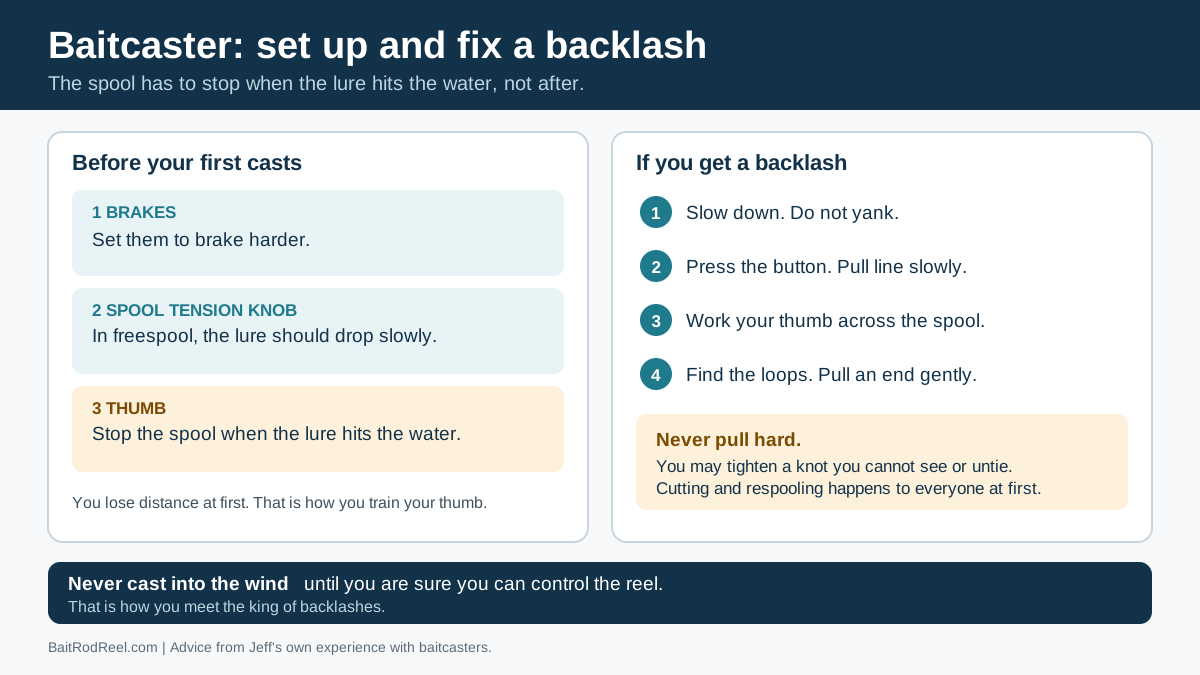
Set it up to be forgiving
For your first casts, these two adjustments make learning much easier:
- Set the brakes to brake harder. Take the time to learn how the braking system on your reel works, and set it to brake harder.
- Adjust the spool tension knob so the lure only drops slowly when the spool is free. To test it, press the button so the spool can spin freely, which is called freespool, and watch how the lure falls. It should drop slowly.
You will lose a lot of distance on your casts with this setup. That is fine. What you are really doing is training your brain to use your thumb to regulate the spool, and this is the most forgiving way to do it. Once your thumb has learned the job, you can loosen the settings a little at a time.
Why backlashes happen
Backlashes are mostly caused by not stopping the spool when the lure hits the water. The lure stops, but the spool keeps spinning and pushes out more line than the lure pulls, and it piles into a tangle.
So the habit to build is simple: the spool needs to stop when the lure hits the water, not after. That is the thumb training.
Watch a good beginner video
Here is a short video I recommend for anyone just starting out: How to Cast and Use a Baitcasting Fishing Rod and Reel - Baitcaster for Beginners by Fishing with Nat. It is not mine, but it is good content that is worth sharing.
How to clear a backlash
Do not get discouraged if you have to cut the line and respool. It happens to all of us when we first try baitcasters. Most backlashes are much easier than that. Here is what I do:
- Slow down. Do not yank on anything.
- Press the button to put the reel in freespool, and slowly pull the line going into the reel. Sometimes the backlash works itself out.
- Work your thumb from left to right across the spool while you work the knots out. That loosens the lines that might be caught up. It helps, but it is not the only thing you need to do.
- Follow the line from where it leaves the reel back onto the spool. You should see loops of line that are keeping it from untangling. Gently pull either end of a loop to see if the knot works out.
Never pull hard, especially on a snag. You will probably be tightening a knot you cannot see and cannot untie, and then you have to cut the line.
Keep the next one from happening
I cannot promise you will never backlash again. But if you keep practicing, and remember that the spool must stop when the lure hits the water and not after, you will get more comfortable and see fewer of them.
And one more thing: never cast into the wind until you are completely sure you can control the reel. If you do, you will be introducing yourself to the king of backlashes.
If you are choosing a first baitcaster
The reel I fish is the Shimano SLX DC, and it has a digital brake with four modes. I think it is a reel meant for everybody. If you want the full details, read my Shimano SLX DC review and my gear ratio guide, which covers which ratio I would pick for a beginner.
Check price on Amazon (affiliate link, opens in a new tab)The Amazon page covers several ratios and hand orientations, so select the one you want before ordering.
Quick recap
- Brakes set to brake harder, and spool tension adjusted so the lure drops slowly in freespool.
- Expect less distance at first. You are training your thumb.
- The spool has to stop when the lure hits the water.
- To clear a backlash: slow down, freespool, pull the line slowly, and look for loops. Never pull hard.
- Do not cast into the wind until you are confident.
The advice in this guide is from my own experience with baitcasters. The video is by Fishing with Nat, and I have linked it because I think it is useful, not because I made it.
Frequently asked questions
How do you cast a baitcaster for the first time?
Learn how to set the brakes so they brake harder, and adjust the spool tension knob so the lure only drops slowly when the spool is free to move. You will lose a lot of distance, but you are training your brain to use your thumb to regulate the spool, and this setup is the most forgiving.
What causes a baitcaster backlash?
Mostly not stopping the spool when the lure hits the water. If the spool keeps turning after the lure stops, it feeds out line faster than the lure is pulling it, and the line piles up and tangles. That is where thumb training comes in.
How do you fix a backlash?
Move slowly. Press the button to put the reel in freespool, then slowly pull the line going into the reel and see if the backlash works itself out. Do not pull hard, because you can tighten a knot you cannot see and cannot untie.
Do I have to cut my line after a backlash?
Sometimes. Some backlashes require you to cut the line and respool, and that happens to everyone when they first try a baitcaster. Most backlashes are not that dramatic and are fairly easy to solve.
Can you cast a baitcaster into the wind?
Not until you are completely confident you can control the spool. Casting into the wind is how you get the worst backlashes.
How long does it take to get comfortable with a baitcaster?
It takes practice. If you keep practicing and remember the spool needs to stop when the lure hits the water, you will get more comfortable and the backlashes will happen less often.